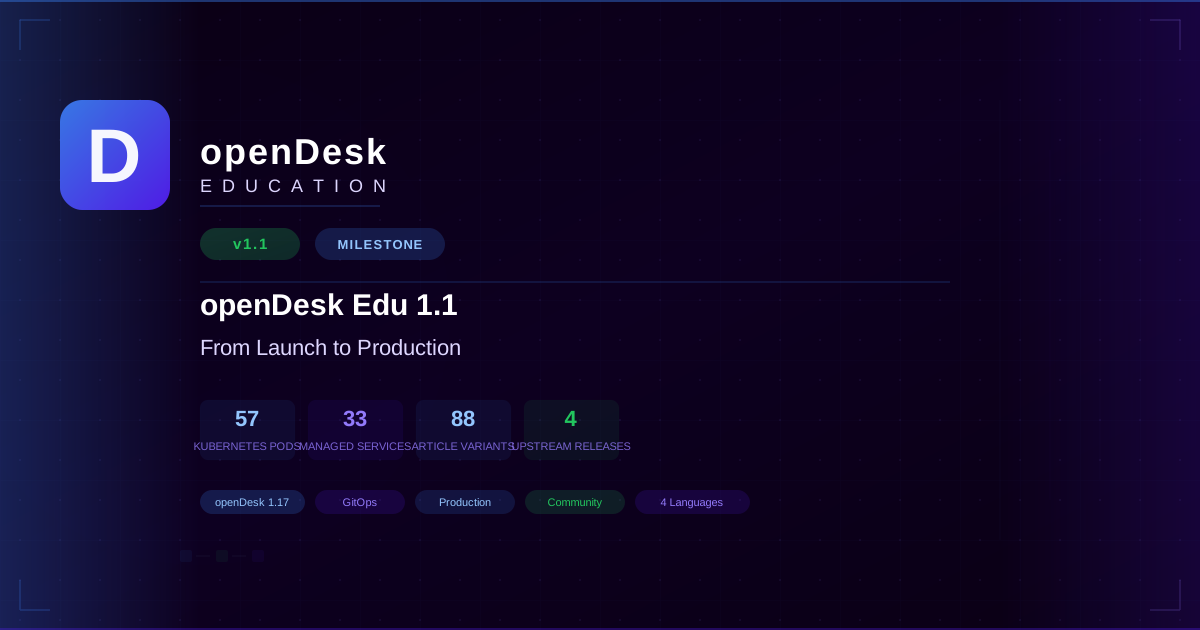
openDesk Edu 1.1: From Launch to Production — Six Months of Growth
Today we are releasing openDesk Edu 1.1, tracking upstream openDesk 1.17. This is our first milestone release — not just a version number, but a reflection of everything built since we launched openDesk Edu on April 15, 2026.
In just over three months, the project has grown from a launch announcement to a fully operational platform running in production, with a growing community of contributors, 22 published articles across four languages, and a clear technical direction. This article tells that story.
At a Glance
| Metric | Value |
|---|---|
| Upstream releases tracked | openDesk 1.13 → 1.17 (4 releases) |
| Production cluster | Multi-node K3s cluster with a comprehensive service suite |
| Blog articles | 22 (EN, DE, FR, ZH — 88 total pages) |
| Community of Practice | 3 sessions, growing participation |
| Contributor agreements | 3 signed |
| Git repositories | GitHub + Codeberg |
Community Growth
The most important development since launch has been the emergence of a community around openDesk Edu. What started as a single-university pilot has become a collaborative project with multiple institutions engaging.
Community of Practice
We launched a regular Community of Practice series, with three sessions so far covering deployment experiences, federation strategies, and the transition from proprietary to open-source digital workplaces. The June 2026 session focused on practical migration patterns, with participation from IT staff across multiple German universities. Recordings and notes are published on this site.
Contributor Onboarding
We've established a streamlined contribution process: a Contributor License Agreement that takes five minutes to sign, clear documentation, and a welcoming review process. Three contributors from outside the core team have signed CLAs, and we've accepted contributions ranging from documentation improvements to configuration fixes.
Multi-University Engagement
While the reference deployment remains the primary instance, we're in active discussions with several other institutions evaluating openDesk Edu for their own environments. The questions we hear — about SAML federation, S3 storage, backup strategies, and operational staffing — are shaping our roadmap priorities.
Multilingual Content Pipeline
All content on this site is published in English, German, French, and Chinese — a deliberate investment in accessibility. Every blog article, documentation page, and announcement reaches all four language communities simultaneously. This pipeline is now well-established, and we invite community members to help maintain and improve translations.
Operational Maturity
The production cluster is the operational proof point for openDesk Edu. What began as a pilot deployment has matured through two dedicated hardening sprints into a production environment.
Production Cluster
- Platform: K3s v1.32.3 on 9 nodes (Debian 12)
- Workloads: A comprehensive service suite across multiple pods
- Identity: Unified SSO via Keycloak with 44 audited clients
- Domain: All services consolidated under a single domain
- Storage: SeaweedFS for S3-compatible object storage
- Backups: k8up with restic, automated and verified
- Monitoring: Prometheus + Grafana dashboards for all services
- Secrets: SOPS with age encryption, deployed via ArgoCD CMP sidecar (no Vault required)
GitOps Pipeline
Our entire infrastructure is managed through GitOps. The deployment guide walks through the full setup, and our GitOps architecture explains the App-of-Apps pattern using ApplicationSets. Secrets are encrypted in Git with SOPS and decrypted at deploy time — no external secret store needed.
CI/CD
Every push to main triggers an automated build pipeline: linting, palette validation, static page generation, Docker image build, and deployment. The same pipeline runs on both GitHub and Codeberg, ensuring deployment independence.
Technical Evolution
Upstream: openDesk 1.13 → 1.17
Since our launch on openDesk 1.13, the upstream project has released four versions — 1.14, 1.15, 1.16, and 1.17 (July 22, 2026). Each release brought component upgrades, security fixes, and stability improvements. The key changes across these releases:
| Component | 1.13 (Launch) | 1.17 (Current) | Notable Changes |
|---|---|---|---|
| OpenProject | 17.2 | 17.6 | Performance improvements, API enhancements |
| Collabora Online | 24.04.x | 25.04.x | Document compatibility, rendering improvements |
| Jitsi Meet | 2.0.10590 | 2.0.11031 | Security fixes, reliability improvements |
| Nubus | 1.17 | 1.21 | UX polish, stability |
| OX App Suite | 8.44 | 8.49 | Calendar sync improvements, security fixes |
| Nextcloud | 31 | 32 | Files performance, new features |
| XWiki | 17.4 | 17.10 | Performance, security hardening |
| Keycloak | 26.x | 26.7 | Security fixes, SAML improvements |
| SeaweedFS | — | Added | New S3 storage layer for object storage |
| Kubernetes secrets | — | Migrated | From Helm-managed to Kubernetes-native secrets |
Beyond version bumps, upstream focused heavily on security hardening across releases — addressing CVEs in OpenProject, Keycloak, and Collabora, and strengthening the overall platform posture.
Key Technical Achievements
SAML Federation with DFN-AAI. We implemented a SAML Service Provider proxy via Keycloak, enabling integration with the German national research federation DFN-AAI and eduGAIN. This means any institution already federated through DFN-AAI can offer their users single sign-on access to openDesk Edu services. The technical deep-dive explains the architecture and includes a call for a shared evaluation instance.
GitOps-Native Secret Management. Managing 126+ secrets across environments without a Vault or External Secrets Operator. Our SOPS + ArgoCD CMP sidecar approach encrypts secrets in Git with age encryption and decrypts them at deploy time. This is fully documented in the secret management guide.
Service Landscape Documentation. We published a comprehensive service landscape overview and platform architecture that maps every component, its dependencies, and its integration points. This living document has already proven valuable for both onboarding and operational troubleshooting.
Content & Knowledge
The openDesk Edu website now hosts 22 articles across four language tracks:
- Strategic: Digital sovereignty in education, the Microsoft 365 dependency trap, why openDesk Edu chose open source
- Technical: Platform architecture, service landscape, deployment guide, GitOps patterns, secret management, SAML federation
- Operational: Progress reports (production cluster), sprint updates, infrastructure deep-dives
- Community: Community of Practice recaps, contributor guides, collaboration tool overviews
Every article is published in EN, DE, FR, and ZH — 88 page variants in total, all statically generated and served from our Docker image.
Roadmap
openDesk Edu 1.1 is a milestone, not a destination. Here's what we're working on next:
| Initiative | Timeline | Status |
|---|---|---|
| Shared federation evaluation instance | Q3 2026 | Design phase |
| Additional component monitoring dashboards | Q3 2026 | In progress |
| Community-driven knowledge base | Q3-Q4 2026 | Planning |
| CI/CD pipeline hardening | Ongoing | Iterative |
| Further upstream tracking (1.18+) | Continuous | Awaiting upstream |
How to Contribute
The roadmap is driven by community needs. If your institution has requirements not yet reflected here — whether a specific integration, a deployment topology, or a policy concern — we want to hear from you.
Join the Community
openDesk Edu is an open-source project under Apache-2.0. Everything we build is public, and we welcome your participation.
- Try it: Deploy openDesk Edu using the deployment guide or review the architecture overview
- Join the conversation: Sign the CLA and submit your first pull request
- Attend a Community of Practice session: Subscribe to updates for the next meeting date
- Connect with us: Reach out to info@opendesk-edu.org for pilot discussions, federation questions, or deployment support
The first three months of openDesk Edu have been about proving the model: that an open-source digital workplace can run in production, serve real users, and sustain a growing community. The next six months are about scaling that model — more institutions, more contributors, more capabilities.
We'd love to have you along for the ride.